
Searching Rapides Parish Criminal Dockets
For a 9th JDC case, start with the Clerk's paid RAPID E-Search service. Look under its Criminal Inquiry category. Coverage starts in January 1984 for the index. Images of Bills of Information go back to May 2003. A complete case number is your strongest match. Without one, search by name and add the filing year, division, or charge category only as needed.
A records search and a calendar search answer different questions. Division calendar pages and event PDFs show upcoming settings. The Clerk holds the actual file and the minutes. If an online copy conflicts with the courthouse record, the physical file controls. A name missing from the portal may sit in another court. It may fall outside coverage, use a spelling variation, or be restricted by law.
- Confirm that the case is a 9th JDC criminal matter rather than a city court, mayor's court, or federal case.
- Open RAPID E-Search and use the Criminal Inquiry route with the most complete lawful identifying information available.
- Compare the case number, division, event, and year before treating a result as the matching docket.
- Use the relevant division calendar to locate a public arraignment, motion, pretrial, trial, or revocation setting.
- Ask the Clerk for a public copy, minute entry, or certified record when an index result does not answer the record question.
Rapides Parish Criminal Docket Coverage
RAPID is a paid subscription, not a free statewide criminal docket. Daily access runs $20 plus $1 per page. Monthly access is $60 plus $0.75 per page. Annual access is $600 plus $0.75 per page. You need a verified email and a supported browser to register. Purchased images stay printable or downloadable for 30 days. The Clerk bars account sharing, scraping, and automated collection.
Away from the portal, the official Search Order Form covers civil, criminal, and marriage searches. It costs $20 for one name and search type, plus $10 for each variation. No turnaround time is promised. The form works well for a defined search. But it won't tell you today's setting; that answer lives on the court calendar.
Inside a Rapides Parish Criminal Docket
A criminal calendar or docket entry can carry a lot. Expect court and division, calendar date, event type, case or docket number, defendant name, charge or bill, counsel, prosecutor, custody or bond status, and any next date or setting outcome. Public pages often show less than the full court record. Never copy private names or identifiers from example PDFs. And remember that a calendar entry alone does not establish the final result.
Know what each document is. A Bill of Information charges the defendant. A minute entry records what happened or was ordered at a setting. A signed order or judgment usually controls the outcome. RAPID's criminal image date covers only Bills of Information. So anything else may take a trip to the Clerk counter or a copy request.
| Case number | The court's identifier; preserve its exact punctuation when requesting a file rather than inventing a local format. |
|---|---|
| Division and event | The 9th JDC assignment and a label such as felony pretrial, motions and arraignments, or revocation. |
| Charge or bill | The charging category or document named in the public record, not a conclusion about guilt. |
| Setting | A scheduled date and time for court activity that can later be continued, reset, or removed. |
| Minute entry | The Clerk's court-event record, subject to public-access and restriction rules. |
| Disposition | An outcome only when expressly stated in an official public minute, order, or docket entry. |
Rapides Parish Criminal Docket Terms
Calendar labels describe the stage or setting the court planned, nothing more. Read them as scheduling terms rather than verdicts. Local rules give a felony a pretrial date at arraignment. Misdemeanors may get pretrial and or trial settings. A sharp docket reader tells a future event apart from a minute entry stating what actually happened later.
- Arraignment
- A criminal proceeding in which the defendant answers the charge and future dates may be set.
- Pretrial
- A preparation setting before trial; it is not a conviction or final ruling.
- Revocation
- A calendar category for a revocation proceeding, not a final conclusion from the label alone.
- Bond forfeiture
- A proceeding or notice associated with bond conditions or appearance requirements.
- Minute entry
- The Clerk's entry of what occurred or was ordered at a court setting.
How a Criminal Case Moves
Cases differ, but the public docket usually runs in a sequence. A charging document comes first. Then comes arraignment, motions or hearings, pretrial work, and a plea or trial setting. After that comes a disposition and, where applicable, sentencing or another post-plea event. The court's division and the minute entries place each event in context. A calendar heading won't show every filing in between.
Docket flow: Filing or Bill of Information → Arraignment → Pretrial → Plea or Trial → Disposition → Sentencing
A felony pretrial, DWI, or bench-warrant label is not a verdict. Treat guilt as unknown until the court says otherwise. Each label names a charge category, a procedural event, or a status, and only the current official record and date give it meaning.
Rapides Parish Criminal Docket Divisions
The 9th JDC master docket materials list Division B with felony trials. They also list felony motions and arraignments, and felony pretrials. Division F publishes criminal revocations and arraignments, pretrials and motions, and misdemeanor arraignments. Division G appears as a criminal section on the master page, though its deep link can be hard to reach. Confirm a current Division G PDF through the master docket page, the Clerk, or court administration.
Local rules assign criminal cases randomly among the criminal divisions by computer. A felony-following-felony rule shapes assignment. A plea stays in the allotted division. Judges may cover another division when needed. So the current calendar and court notice beat any older roster or PDF.
Courts That Hold Criminal Dockets
For a district-court case, two offices run the Rapides Parish criminal docket. The 9th JDC hears the matters. The Rapides Parish Clerk of Court's Criminal Department keeps the paper. Felony, juvenile, misdemeanor, and traffic pleadings for the 9th JDC all pass through that department. The court minutes tied to those cases do too. So do the subpoena records, bench warrants, bond-forfeiture notices, and victim notifications. None of that turns every local criminal matter into a district-court docket record.
Alexandria City Court works within its own published limits. Pineville City Court runs a separate route with its own clerk. Mayor's and magistrate's courts can take ordinance matters. A federal criminal case goes through the Western District of Louisiana. It uses PACER and the federal clerk rather than RAPID. Read the citation or charging paper first. It tells you which court actually holds the record before you make a request.
Rapides Parish Criminal Docket Access
When RAPID leaves you short, go straight to the Clerk's public-service channels. The counter sits on the first floor of the courthouse. The address is 701 Murray Street in Alexandria. Hours run 8:30 a.m. to 4:30 p.m., Monday through Friday, minus legal holidays. The main number is 318-473-8153. A call can steer your request. The Clerk will not take copy orders by phone or read legal documents aloud, though.
For copies, use the General Public Copy Request in writing or in person. Certified copies are an option, and delivery can come by mail or fax. Mail requests need a self-addressed stamped envelope. Faxed requests go to 318-473-4667, attention Public Service, under the published process and charges. The Clerk notes that public-access computer information is largely online. So ask at the counter about current terminal access. eClerks LA and LCRAA serve as statewide clerk-access infrastructure, not substitutes for the Rapides Criminal Inquiry.
Rapides Clerk Criminal Department
701 Murray Street
Alexandria, LA 71301
318-473-8153
Criminal Department responsibilities and records information
Filing a new pleading is not the same as pulling a record. The Criminal Department takes no fax filings. Its 2026 notice ended attorney fax and mail filing. It kept in-person and approved electronic routes. The Clerk's Criminal Department page lays out the local criminal records and filing functions.
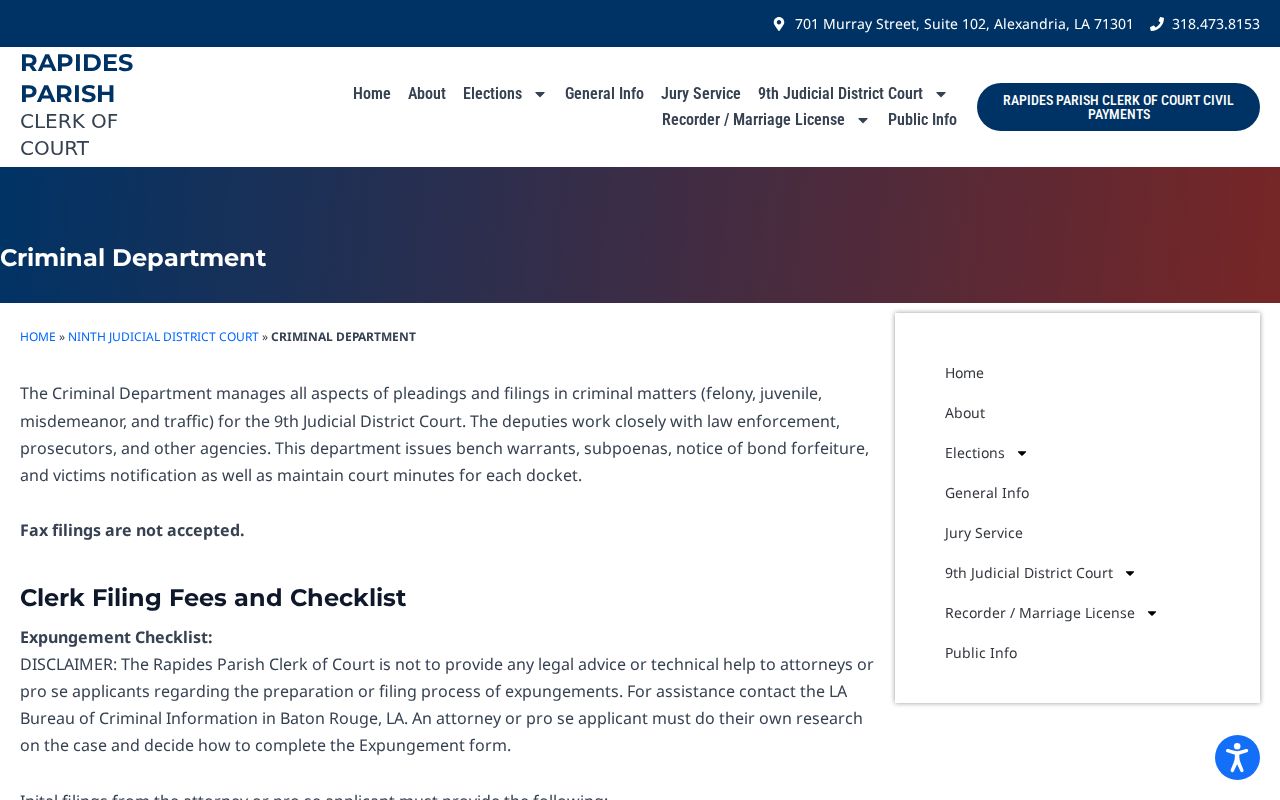
The department holds the 9th JDC criminal record you likely need. A city or federal case, though, takes its own court route.
Sealed Dockets and Public Access
Public does not mean unrestricted. Open criminal dockets and minute entries may be viewable, but limits apply. Louisiana law and the 9th JDC's juvenile page keep juvenile proceedings closed as a rule. Anything expunged stays confidential. A sealing order, privacy redaction, protected domestic information, or a restriction on law-enforcement material can shrink what an online docket search returns. The same limits apply to a copy request. Remember the line between a public court docket and an investigative police file.
Key criminal access rules:
R.S. 13:5992 provides public electronic criminal minute-entry or summary access for covered cases filed on or after January 1, 2020, subject to restrictions.
Children's Code art. 412 limits public access to juvenile records and proceedings.
CCP art. 973 makes expunged arrest and conviction information confidential except as the statute allows.
R.S. 44:3 distinguishes certain public initial reports and charging records from restricted investigative material.
If you are denied access, ask whether the whole record is closed or just certain pages or fields. A redacted copy, minute entry, or docket summary may still exist. Do not push for a workaround on sealed or juvenile material.
Rapides Parish Criminal Docket Minutes
Louisiana's Truth and Transparency provision covers criminal cases filed on or after January 1, 2020. It requires public electronic access to a minute entry or summary through the LCRAA framework. Images of every filing are not required. That gap explains why a RAPID result, a public calendar, and the Clerk's file can show different levels of detail. Note the source and capture date of any entry before you rely on it. The official R.S. 13:5992 text sets out the criminal minute-entry access framework.
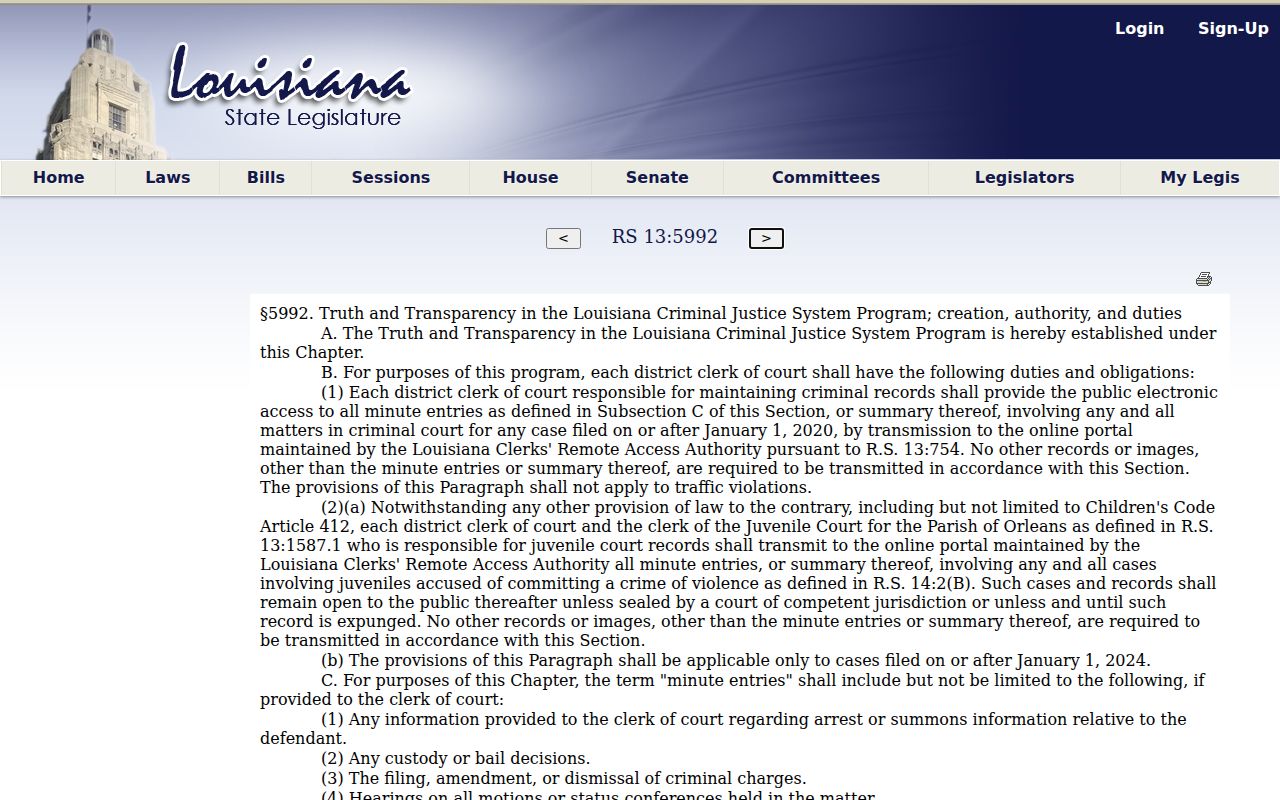
A public minute summary can clarify a docket event quickly. When the exact text matters, though, get a certified copy or inspect the official file.